
THE NORTHFIELD LODE
A History of the Northfield Mine, Destiny County, Colorado
By the autumn of 1889, there was little reason for anyone in Destiny to pay much attention to the broken ridge northeast of town.
There were better places to prospect.
Men had been pulling gold from the mountains of Colorado for thirty years, and by then every fellow with a burro, a pick, and enough whiskey to mistake optimism for geological knowledge had examined half the visible quartz in the Front Range.
The ridge above Destiny had been examined too.
More than once.
It had never amounted to anything.
That changed in October.
1889 — The Stone That Didn’t Look Like Gold
Elias Northfield wasn’t looking for gold when he found it.
He was looking for water.
Northfield kept a small cabin about two miles northeast of Destiny and had spent much of October cutting timber. An unusually dry autumn had reduced the little spring below his place to mud, so he followed the drainage uphill looking for another seep.
Near the crest he found a place where frost and runoff had opened the soil beneath the roots of a fallen pine.
There was quartz underneath.
That alone meant nothing.
What interested Northfield was its color.
The exposed rock was stained yellow-brown and red where water had worked through cracks in it. When he broke a piece loose with the poll of his axe, the fresh surface was gray-white quartz with scattered metallic grains.
He knew enough not to call them gold.
Pyrite had made fools of better men.
Northfield knocked several pounds loose, wrapped the pieces in an old flour sack, and carried them back to Destiny.
Three days later the rock went out for assay.
The result came back high enough that Northfield assumed there had been a mistake.
He sent another sample.
Then a third.
There had been no mistake.
What Northfield had exposed was part of a gold-bearing fissure vein. Much of the precious metal wasn’t visible as native gold at all. It occurred with sulfides and telluride minerals within the quartz.
Northfield had found gold.
The more important question was how much.
The Discovery
On November 4, Northfield returned to the ridge with Samuel Pike and Thomas Bell.
They exposed twelve feet of the vein before snow stopped them.
It wasn’t impressive.
The vein pinched to scarcely three inches in one place, widened to nearly two feet in another, then disappeared beneath fractured country rock.
Bell reportedly looked at the miserable thing and said:
“That’s a hell of a narrow place to put a fortune.”
Whether Bell actually said it would later become impossible to establish.
Destiny nevertheless remembered that he had.
They staked the ground before winter.
They called it the Northfield Lode.
1890 — Sinking on the Vein
Work resumed after the spring thaw.
There was no machinery on Northfield Hill.
There wasn’t even a proper road.
Everything that went up the mountain went by man, mule, or horse.
Northfield, Pike and Bell stripped the surface over the discovery and began sinking directly upon the vein.
Pick.
Hammer.
Drill steel.
Black powder at first, and increasingly dynamite where harder rock demanded it.
The work followed a rhythm that miners throughout the West would have recognized.
One man held the drill.
Another swung the hammer.
Turn the steel.
Strike.
Turn.
Strike.
Turn.
Strike.
When the hole was deep enough, it was charged.
After the blast, the men waited for the smoke and fumes to clear, then returned to shovel broken rock into buckets.
Most of it was worthless.
Some wasn’t.
At twenty-seven feet they encountered a narrow streak unlike anything they had seen near the surface.
Dark sulfides appeared through the quartz.
The best material was carefully separated from waste rock by hand.
Northfield sent samples away.
This time the assay caused trouble.
The selected ore was extraordinarily rich.
Word reached Destiny before Northfield did.
Within weeks prospectors were crawling over neighboring slopes.
Claims appeared with names considerably more optimistic than their geology:
The Providence.
Lucky Boy.
Silver Queen.
Morning Star.
Last Chance.
The Last Chance eventually proved prophetic.
It produced nothing.
Northfield Hill
By the summer of 1891, the discovery shaft was nearly seventy feet deep.
The Northfield Lode had revealed its personality.
It was not a broad, dependable body of milling ore.
It was worse.
It was tantalizing.
The vein might carry excellent values for twenty feet and then become nearly barren. Rich seams appeared inside otherwise ordinary quartz. Telluride-bearing material sometimes occupied only inches of the vein.
The miners began calling those rich sections pay streaks.
Northfield couldn’t simply mine everything and make money.
The valuable ore had to be followed.
And the vein didn’t particularly care where Elias Northfield wanted it to go.
Still, enough ore came out to justify further development.
A wagon road was cut from Destiny.
A blacksmith shed appeared beside the workings.
Then an ore house.
Then a powder magazine, deliberately placed away from everything else because even nineteenth-century miners possessed a healthy appreciation for not storing dynamite beside the lunch pail.
A bunkhouse followed.
By autumn, twelve men were working on Northfield Hill.
Destiny began calling the collection of buildings simply the Northfield.
The mine was becoming part of the town.
The No. 1 Tunnel
The shaft presented an obvious problem.
Everything had to be raised.
Men.
Ore.
Waste.
Water.
Timber.
Equipment.
So Northfield’s superintendent proposed attacking the vein from below.
Several hundred feet downslope, the company began driving a horizontal opening into the mountain.
Officially it became the Northfield No. 1 Adit.
Nobody in Destiny called it that.
They called it the Northfield Tunnel.
The objective was simple: drive through barren country rock until the tunnel intersected the vein beneath the discovery workings.
If they calculated correctly, they would gain inexpensive access to deeper ore and much of the mine could drain naturally through the tunnel.
If they calculated incorrectly, they would spend a great deal of money digging an exceptionally straight cave.
For months the tunnel produced nothing.
Four feet.
Six feet.
Sometimes less than that in a working day.
Drill.
Blast.
Muck.
Timber where necessary.
Lay more track.
Move forward.
By early 1892, ore cars were running on narrow-gauge mine rail from the face to the dump outside.
Then, on February 17, the character of the rock changed.
The following shift broke into quartz.
They had found the Northfield vein.
And it was carrying ore.
Northfield Lot No. 1
That discovery changed the company.
Outside money arrived.
The rough wagon road was improved. A larger ore house was built. Additional underground development began along the vein from the tunnel intersection.
Northfield Hill echoed with blasting.
Every few days wagons descended toward Destiny carrying sacks and small lots of carefully sorted ore.
And the Northfield became respectable enough that its owners wanted something more permanent than stakes hammered into Colorado dirt.
They sought patent proceedings on the claim.
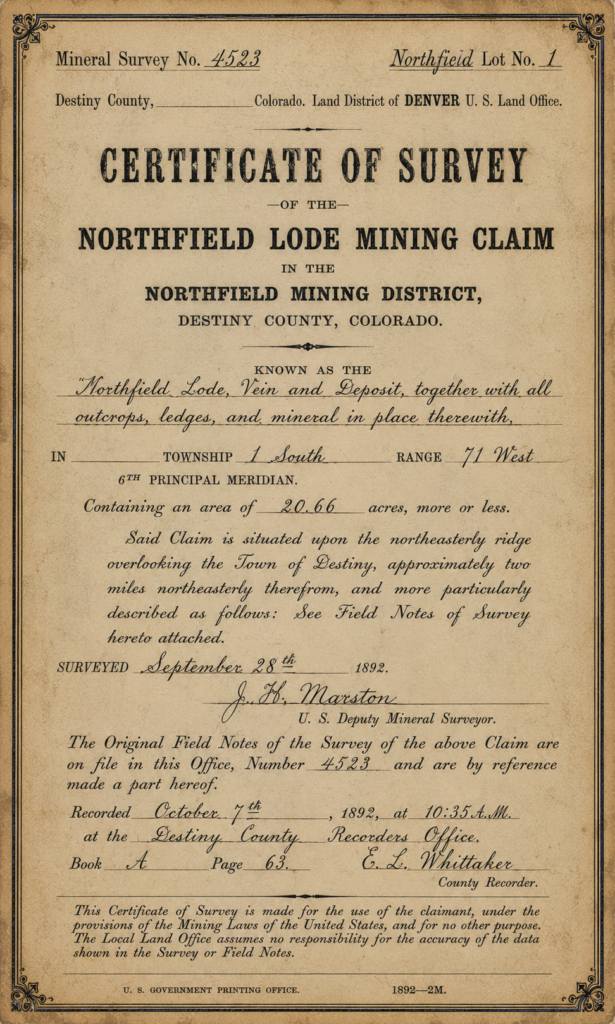
On September 28, 1892, United States Deputy Mineral Surveyor J. H. Marston climbed Northfield Hill.
He surveyed the property.
The resulting government survey identified it as:
Mineral Survey No. 4523
Northfield Lot No. 1
Northfield Lode Mining Claim
The surveyed claim contained 20.66 acres.
Its location was described as lying upon the northeasterly ridge overlooking Destiny, approximately two miles from town.
On October 7, the survey was recorded at the Destiny County Recorder’s Office.
Book A.
Page 63.
10:35 in the morning.
Elias Northfield had picked up an ugly piece of quartz three years earlier.
Now his name was written into the land records of Colorado.
The Year Everything Changed
Then Colorado collapsed.
Silver prices crashed amid the Panic of 1893.
Mines closed.
Investment disappeared.
Men who had been earning underground wages appeared in towns looking for anything that paid.
Colorado mining communities dependent upon silver were devastated.
Northfield should have died with them.
It didn’t.
Because Northfield wasn’t principally a silver mine.
It was a gold mine.
Gold production was already substantial in Boulder County-type Front Range districts—the historical Boulder County output actually peaked at 47,556 ounces in 1892—and gold mining remained important after the silver crash.
Suddenly the strange little mine next door in Destiny County became more attractive.
Capital that wanted nothing more to do with silver began looking at gold properties.
Northfield found investors in Denver.
For the first time, the mine had money.
And Elias Northfield was about to lose control of it.
The Northfield Gold Mining Company
The Northfield Gold Mining Company was incorporated in Denver early in 1894.
Northfield retained shares.
He did not retain command.
The new company installed a steam-powered hoist at the discovery shaft and expanded the surface plant.
A proper headframe rose above the ridge.
Compressed-air drilling would eventually replace much of the brutal hand drilling in the principal workings.
The No. 1 Tunnel was widened in places.
Track ran underground.
Ore cars replaced wheelbarrows.
New stopes were opened above and below the tunnel level.
Twenty-eight men worked the property.
Then thirty-five.
Then forty-three.
Destiny changed with them.
Breakfast at the diner started earlier.
The saloon stayed open later.
Rooms became scarce.
Freight wagons climbed Northfield Road daily.
Children in Destiny could tell whether the mine was working from the sound.
Boom.
Wait.
Another.
Boom.
Sometimes the mountain remained quiet for an hour.
Then:
Boom.
Nobody looked up anymore.
The Gold Nobody Could See
Visitors were frequently disappointed by Northfield ore.
They expected gold.
They expected yellow metal glittering in white quartz.
Occasionally they saw it.
Usually they didn’t.
The valuable material could be remarkably unimpressive.
Gray quartz.
Pyrite.
Dark streaks.
Metallic specks.
The mine’s gold was frequently bound in telluride minerals and associated with sulfide-rich vein material.
It had fooled Elias Northfield once.
Now the company employed an assayer specifically so it wouldn’t fool them.
Every working face was sampled.
Ore was sorted.
Waste was discarded.
Promising material was stockpiled separately.
And sometimes a section that looked worthless returned an excellent assay.
Other times beautiful mineralized quartz proved barely worth hauling downhill.
The Northfield developed a saying:
Never trust the rock until the assayer does.
The Bonanza Stope
At 4:20 on the afternoon of June 11, 1895, miners working beyond the eastern end of the second level fired a round.
When they returned after the smoke cleared, the freshly broken face looked different.
The vein had widened.
Not dramatically.
Perhaps fourteen inches.
But nearly the entire width was heavily mineralized.
Samples went immediately to the assay office.
Nobody said much that evening.
The following morning, Superintendent Charles Mercer walked into the office, read the results, and asked that the samples be run again.
They were.
Then a third sample was prepared.
Same answer.
Northfield had encountered the richest ore body in its history.
The miners called it the Bonanza Stope.
For eleven months it produced astonishingly valuable ore.
The company stopped discussing production figures publicly.
Armed men accompanied some shipments.
Investors arrived from Denver.
A newspaper declared Northfield destined to become one of Colorado’s great gold mines.
Someone painted:
NORTHFIELD
THE GOLDEN MOUNTAIN
on the side of the ore house.
Elias Northfield hated it.
He had spent enough time underground to know something the investors hadn’t learned yet.
The vein had fooled them before.
In April, the Bonanza narrowed.
By May it was eight inches.
Then four.
Then two.
On May 29 the night shift reached the end of it.
The rich ore simply stopped.
They drove ahead.
Nothing.
They raised above it.
Nothing.
They sank below it.
Nothing.
Crosscuts were driven into both walls looking for a displaced continuation.
Nothing.
The Golden Mountain had become ordinary rock.
Again.
The Denver directors demanded answers.
The superintendent demanded footage.
The miners kept drilling.
Elias Northfield said only:
“Mountain never promised anybody anything.”
Because that became the Northfield Mine’s epitaph long before anyone realized it.
Going Deeper
The failure of the Bonanza Stope did not end the Northfield.
It changed the argument.
The Denver directors wanted to cut expenses and work the remaining known ore. The miners who actually knew the ground believed the opposite.
The Northfield vein had not ended.
It had moved.
Or split.
Or faulted.
Or done any one of the dozen irritating things mineral veins were perfectly capable of doing while investors sat in offices insisting that geology behave itself.
Superintendent Charles Mercer authorized additional exploration.
The No. 2 Tunnel was started below the original workings.
Unlike No. 1, which had been designed primarily to intercept known vein, No. 2 was meant to reach the structure at significantly greater depth.
By December, the heading had been driven several hundred feet.
It cut quartz.
Then sulfides.
Then ore.
Not bonanza ore.
But enough.
The Northfield was alive again.
No. 3
A second mineralized fracture had been noticed repeatedly in the eastern workings.
It appeared roughly parallel to the Northfield vein.
Some believed it was a branch.
Others thought it might be a second vein entirely.
Mercer ordered a crosscut.
That became the No. 3 Tunnel.
The men hated it.
It was wet.
It was fractured.
The ground required considerably more timber than the older workings.
And for nearly six months it produced precisely enough mineralization to keep management interested without producing enough gold to justify anyone’s optimism.
The miners gave it another name.
The Promise.
Not because it promised wealth.
Because, according to one of the shift bosses:
“Every damn week Mercer promises we’re almost there.”
They never got there.
The No. 3 was eventually reduced to exploratory work and then abandoned.
But it remained open underground for decades.
The Forgotten Drift
In the summer of 1895, while the Northfield was driving exploratory workings in nearly every promising direction, a small crew began a narrow drift toward Destiny.
The idea was simple enough.
Fractures encountered in the lower workings suggested that a branch of the Northfield vein might continue westward beneath the lower ridge. If it did, the company wanted to find it before somebody else did.
At first, the rock encouraged them.
Thin seams of quartz appeared in the face. Pyrite showed in freshly broken stone, and occasional samples carried traces of gold. Nothing worth mining, but enough to keep the superintendent interested.
Ten more feet.
Another twenty.
Another round of holes drilled and fired.
The drift continued toward town.
As the weeks passed, the quartz became thinner. Assays grew poorer. What had looked like a promising branch became little more than a mineralized fracture through otherwise ordinary country rock.
Still, they followed it.
By late summer, survey calculations placed the heading nearly beneath Destiny itself.
The miners drove one final stretch to make certain.
There was nothing.
The last face showed fractured rock crossed by a thread of barren quartz. Samples taken from it returned no values worth pursuing.
The superintendent ordered the work stopped.
The men collected their tools and equipment, but there was little reason to remove everything. Short lengths of rail remained on the floor. Timber remained wherever the ground required support. Drill holes from the final round remained in the face.
Nobody bothered giving the working a proper name.
On an underground working sheet it appeared simply as:
WEST EXPLORATION DRIFT — ABANDONED
And that was nearly the end of its history.
Several years later, after work had moved elsewhere in the Northfield, parts of the abandoned drift collapsed. Nobody was inside. Nobody attempted to reopen it.
There was no ore in the western heading and nothing there worth risking men or money to recover. The fall simply severed the abandoned dead end beneath what would become Main Street Destiny from the Northfield workings farther northeast. Above it, Destiny went about its business. Generations have walked the boardwalk overhead without knowing that somewhere beneath their feet remained a few hundred feet of hand-drilled nineteenth-century rock.
At one end stood the unfinished face where the Northfield miners had stopped in 1895.
At the other lay the ancient rockfall that had sealed it from the mine.
Between them was nothing anyone wanted.
So Destiny forgot it existed.
The Deep Tunnel
By the turn of the century, Northfield’s greatest problem was no longer finding ore.
It was reaching it economically.
The workings had gone deeper.
Water had become troublesome.
Hoisting waste and ore through the upper shafts cost money.
Pumping water cost more.
And every foot downward made both problems worse.
An engineer named William H. Rourke proposed an audacious solution.
Don’t pump the water uphill.
Tunnel underneath it.
His proposal called for a long drainage and haulage tunnel driven from the Destiny side of the mountain toward the deepest Northfield workings.
It would intersect the Northfield vein far beneath the existing mine.
If successful, water from large portions of the mine could drain naturally through the tunnel.
Ore could eventually be hauled horizontally rather than hoisted hundreds of feet vertically.
And most importantly:
The tunnel would give Northfield access to virgin ground far beneath anything yet explored.
The directors approved it.
Barely.
Work began in August 1901.
The official name was the:
NORTHFIELD DEEP DRAINAGE AND DEVELOPMENT TUNNEL
Nobody in Destiny called it that either.
It became simply: The Deep.
Breakthrough
Three years after work began, the Deep Tunnel intersected one of the older Northfield workings.
Men working underground heard drilling before the headings met.
At first it was faint.
A tapping through stone.
Then louder.
On the morning of October 19, the last round was fired.
When the smoke cleared, men from opposite ends could see one another through the broken rock.
After years of work, the Northfield had been pierced from beneath.
Water began running downhill through the new drainage ditch almost immediately.
For weeks afterward, the flow increased as previously flooded sections drained.
The company celebrated.
Destiny celebrated.
Someone rolled a barrel of whiskey up to the portal.
Someone else rolled it back down after Superintendent Mercer discovered it.
And once the water receded, the miners began exploring ground that had previously been inaccessible.
That was when they found something unexpected.
The Northfield vein continued downward.
And it was getting stronger.
The Lower Northfield
The Deep Tunnel established what would thereafter be called The Deep.
From there, miners drove east and north.
Several raises connected upward with older workings.
A winze was sunk below the Deep Level.
That distinction matters.
A shaft descends from the surface.
A winze is sunk downward from an underground level.
So Northfield became a complicated mature mine.
And by 1906, after seventeen years of excavation, there are parts of Northfield that even the men working there don’t know very well.
Old headings disappear from updated maps.
Short exploratory drifts are forgotten.
Timbers collapse.
Sections are sealed after rock falls.
The surviving mine maps aren’t necessarily complete.